
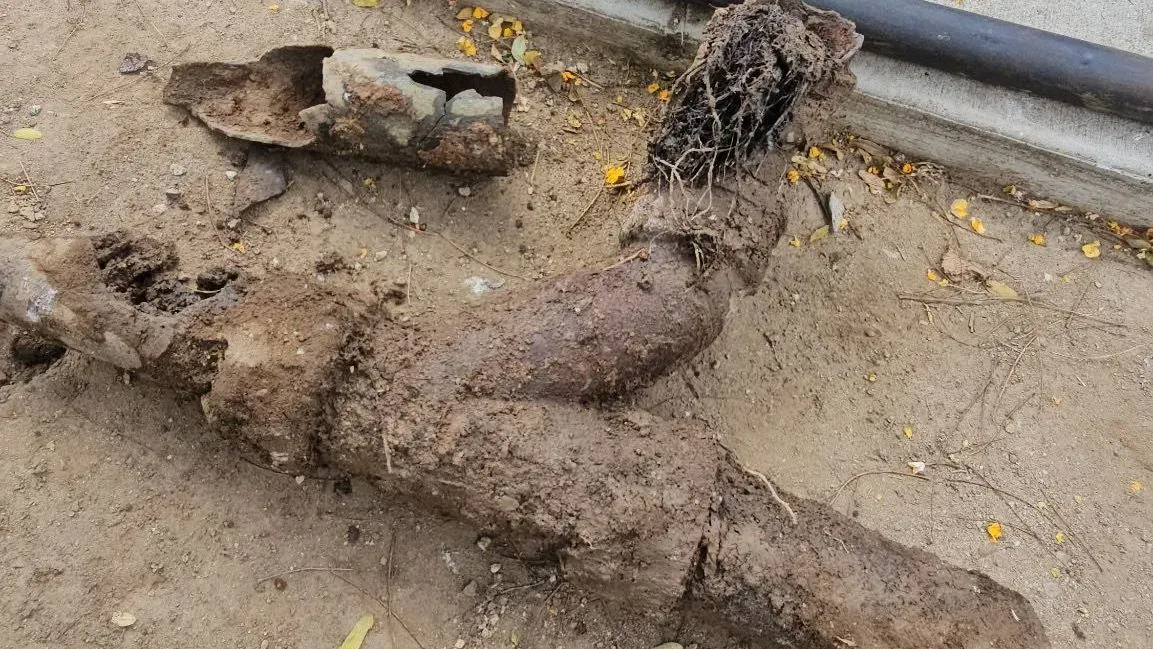
A failing sewer line rarely fails all at once. It sends warnings first, sometimes for months, and the homeowners who catch them early tend to face a far smaller job than the ones who meet the problem as a backup. The photo above is what we pulled out of one Los Angeles yard: an old line with tree roots grown straight through the joint. Before it came out of the ground, it announced itself through the signs below.
The six warning signs
- More than one slow drain. A single slow sink is a fixture problem. Several fixtures slowing down in the same stretch of days points at the line they share.
- Gurgling toilets. A toilet that gurgles on its own, or when another fixture drains, is moving air it should not be moving. Trapped air in the line is a blockage symptom.
- Sewage odor. Sewer gas in the house, the yard, or from a floor drain means the line is not carrying everything away, or a trap somewhere has been pulled dry.
- Backups at the lowest drain. When the main line blocks, wastewater finds the lowest exit: a tub, a shower, a floor drain, or the outdoor cleanout. If using an upstairs fixture brings water up downstairs, that is the pattern.
- A soggy or unusually green patch of yard. A leaking lateral feeds one spot of ground. In a dry Los Angeles summer, the lush patch is the suspect patch.
- The same clog, again and again. A main-line clog that keeps returning after clearing usually has a structural reason: roots, a sag in the pipe, or a joint that has shifted. Clearing treats the symptom. The reason stays.
Why sewer lines fail under Los Angeles homes
A large share of the housing here went up between the 1920s and the 1970s, and many of those houses still drain through their original clay or cast iron laterals, the section of sewer pipe that crosses the homeowner's own property. Clay pipe comes in short segments with a joint every few feet, and every joint is an opening. Tree roots follow the moisture, enter at the joints, and grow until they are a filter that catches everything. Cast iron corrodes and flakes from the inside. And the ground itself moves, settling and shifting until a section of pipe sags into a low spot that collects debris.
None of that is anyone's fault. It is what several decades do to buried pipe, and it is why the warning signs above cluster in older neighborhoods.
What you can do right now
- Stop running water you do not need. Every gallon in is a gallon the blocked line has to pass.
- Skip the washing machine and dishwasher until the line is looked at. They discharge large volumes fast.
- Note which fixtures act up and in what order. That pattern is genuinely useful to whoever works on the line.
- Find your sewer cleanout, usually a capped pipe near an outside wall or in the yard. Knowing where it is saves time on the visit.
How we evaluate it
When a sewer camera inspection is appropriate, we use specialized equipment to help evaluate accessible sections of a drain or sewer line and explain the findings. Camera access and visibility depend on the condition of the line, available access points, and whether cleaning is required before inspection.
What happens after depends on what the line actually shows. Heavy buildup and root intrusion in a structurally sound pipe is a different situation from a collapsed or sagging section, and the two lead to different recommendations. We focus on proper diagnostics and dependable workmanship, not temporary shortcuts or one-size-fits-all recommendations.
How we can help
Depending on what the evaluation finds, the path forward might be a thorough cleaning, a repair to one section, or a larger conversation about the line. These are the three services that cover that ground.
